How to triple energy efficiency spending by 2030 and beyond
Super ESCOs and their impacts

The world is investing hundreds of billions of dollars annually in energy efficiency (EE), yet spending remains far below what is required to achieve global climate and energy goals. While countries committed to doubling the rate of EE improvement by 2030 at COP28, annual investment will need to more than triple from current levels to close the gap.
💡In 2025, global investment in EE1 reached USD 773 billion across buildings, industry, and transport.2 However, this remains well below the USD 1.9 trillion in annual investment required to meet the COP28 pledge to double EE market growth by 2030.3 By comparison, renewable energy (RE) investments totaled USD 780 billion in 2025 but will need to be increased to USD 1.5 trillion annually by 2030 to remain on track.4
According to IRENA, 20–25% of CO₂ emission reductions by 2050 could come from EE improvements, which is equivalent to around eight to 10 gigatonnes of CO₂ saved each year.5,6
One model is attracting increasing attention for its capacity to scale investment while reducing risks for energy end users: The Super ESCO.
In the current global energy savings performance contracting (ESPC) market, companies enter into contracts with energy end users to design and implement energy savings projects, and company remuneration is linked, in some form, with project performance. The ESPC market is valued at approximately USD 33.4 billion and is projected to reach USD 62.6 billion by 2033, with China and the US being the leading markets, followed by Europe, while the rest of the world remains marginal7. Energy service companies (ESCOs), the organizations that use ESPC in their operations, are a key driver of EE investments and reductions in energy consumption. Yet, in all markets, the use of ESPC remains fragmented, legal frameworks vary widely, and the financial capacity of the institutional and private sectors is limited and, therefore, cannot serve to eliminate the lack of financing capacity at the end-user level. In most markets, ESCO activities are still underdeveloped or nonexistent.
While EE technologies are widely available and financially viable in many cases, the challenge of transforming these opportunities into investable, scalable projects remains. Closing this implementation gap is now one of the most pressing priorities for achieving global energy and climate objectives.
The Super ESCO model is a way of accelerating the use of ESPC and the development of ESCO markets, and the model is now being piloted and deployed in many countries (e.g. Spain, Kenya, Uganda, South Africa, Rwanda and others). Such organizations have the potential to become one of the most effective mechanisms to bridge the EE investment gap to unlock massive energy savings and significant CO₂ emission reductions.
What is a Super ESCO?
A Super ESCO is described as an entity set up either by public and/or private investors and that offers full ESPC services to clients through a shared savings agreement, including adapted financing, while subcontracting project design and implementation to private sector ESCOs that guarantee the expected savings to be realized. Given their unique status in the location where they operate, Super ESCOs either develop new markets for existing private sector ESCOs or help introduce the Super ESCO concept in countries to initiate the development of ESCOs.
As specialized organizations, Super ESCOs must possess all necessary capacities to develop adapted ESPC concepts and produce complete sets of documentation (client proposals, procurement and contract templates, measurement and verification plans, etc.). They must have solid capacities to identify business opportunities and available technologies, develop projects, and cover implementation costs, among other things, in specific environments. Mostly, they must be able to structure adapted financing capacities to invest in EE projects and be reimbursed in the long term through a share of the generated savings. This means Super ESCOs make it easier to identify untapped opportunities for using ESPC in target markets and are not competitors of ESCOs but rather accelerators that help develop and grow the market.
Conceptual Model of a Super ESCO
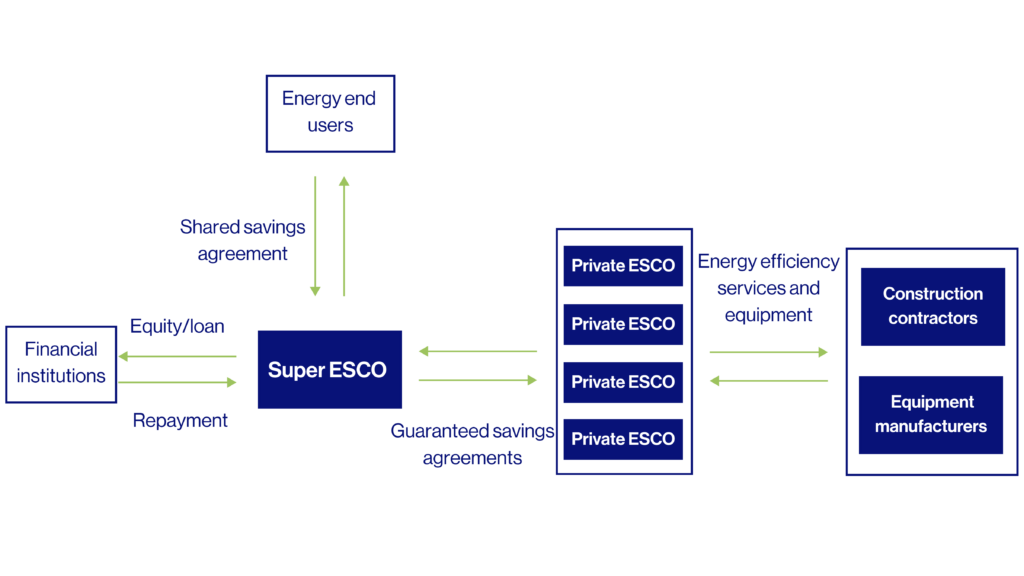
Hence, Super ESCOs do more than implement projects. They address one of the main barriers limiting EE deployment worldwide: The inability of many organizations to access financing, manage technical risks, and develop projects at scale.
Structure of a Super ESCO
A Super ESCO can be structured either as a public entity or private entity.
- Public Super ESCOs: Public Super ESCOs are mainly used by governments to facilitate the use of the Super ESCO concept by eliminating the need for individual end users to tender (ministries, public organizations, etc.) since they can contract directly with public Super ESCOs. They enable the development of centralized expertise to tender and manage ESPCs with private sector ESCOs. They also leverage public funds and attract institutional and commercial financing, which means Super ESCOs are one of the mechanisms used to overcome barriers hindering the large-scale implementation of public sector EE projects. The Etihad ESCO in Dubai9 and TAQA Energy Services10 in Abu Dhabi, both in the United Arab Emirates, Tarshid11 in Saudi Arabia, as well as ÉcoÉnergie 36012 in Canada are prime examples of this model.
- Private Super ESCOs: Private Super ESCOs invest in projects subcontracted to ESCOs and take on the commercial risks of client non-payments while leaving the technical risks to the subcontracted ESCOs. Hence, private Super ESCOs initiate and develop projects, sign contracts, and maintain a global relationship with energy end users for the whole duration of contracts. Private Super ESCOs fulfil the same role as public Super ESCOs but are focused only on private sector energy end users as they are not allowed to work directly with public sector entities. SOFIAC Canada,13 SOFIAC France,14 Climary15 in the Philippines, and the Fonds African de l’Efficacité Énergétique (FAEE) in Morocco are prime examples of private Super ESCOs.
Key lessons and main barriers in developed markets
While the Super ESCO concept is now well established in several markets, its evolution has revealed both the conditions for success and the structural barriers that continue to limit further use and adoption of the concept.
The turning point came in 2013 with the creation of Etihad ESCO in Dubai. For the first time, a dedicated organization was established to systematically develop an EE market using the Super ESCO model. Its success demonstrated that ESPC could be deployed at scale and sparked similar initiatives across the region.
Created through an initiative of the Dubai Supreme Council of Energy and the leadership of the Dubai Electricity and Water Authority, Etihad ESCO aimed to develop an EE market, create jobs through new retrofit projects in facilities as part of its efforts to make Dubai a regional and global leading example of EE, all of which is in line with the Demand Side Management Strategy 2030 that is aimed at reducing power and water consumption by 30% by 2030. Etihad ESCO was followed by the creation of other public sector Super ESCOs in the region, mainly Tarshid in Saudi Arabia and TAQA Energy Services in Abu Dhabi
An important revolution came in the 2020s with the development of private sector Super ESCOs, starting with SOFIAC Canada. Initiated by Econoler, one of the leading firms in the use of ESPC and an advisor in the creation of Etihad Super ESCO, SOFIAC Canada demonstrated that energy efficiency could attract institutional investors when projects are aggregated, risks are properly managed, and repayments are linked to verified project performance.
SOFIAC Canada raised USD 135 million, USD 73 million of which came from public funding through the Canada Infrastructure Bank, meaning that each public dollar leveraged USD 0.85 in private capital. In comparison, the renewable energy sector often leverages USD 3–4 in private investment per public dollar,16 and the sector has leveraged more in mature markets. As of 2025, SOFIAC Canada’s portfolio had avoided around 167 tCO₂ per USD 1 million invested, while solar photovoltaic technology typically avoids about 800 tCO₂ per USD 1 million.
Super ESCOs typically achieve 25–60% energy savings in a facility, and they target sectors that renewable energy cannot decarbonize effectively, such as buildings, heating, and industry. Unlike renewable energy that is focused on supplying clean energy, Super ESCOs are focused on reducing existing demand, and their impact is measured in CO₂ avoided relative to fossil fuel use. They are also focused on reducing peak demand on a reliable basis, which is very often key in the energy transitioning process of energy grids. Energy efficiency measures can therefore provide a more cost-effective means of reducing peak demand than adding new renewable generation alone.
However, these figures alone can be misleading. They measure only direct carbon impact, ignoring the wider economic, social, and system-level benefits that Super ESCOs deliver. Super ESCOs provide co-benefits well beyond carbon reductions, including direct cost savings and increased productivity, improved asset value (since efficient buildings attract higher rents and resale prices), better indoor comfort and air quality, and greater climate resilience. For clients, Super ESCOs also generate immediate financial advantages such as positive cash flows from day one, no impact on corporate financing capacity, optimized use of subsidies, full asset ownership upon installation, and reduced future CAPEX needs through accelerated asset replacements. Hence, renewables and Super ESCOs must work hand in hand: Renewables serve to clean the energy supply, while Super ESCOs enable the implementation of deep building and industrial energy retrofits that reduce the amount of needed energy supply.
Scaling the Super ESCO model remains far from straightforward.
Despite the strong technical potential and proven results of Super ESCOs, persistent structural barriers limit their development. First, Super ESCOs are technically, legally, operationally, and financially complicated structures. Structuring complex financial structures remains the main challenge. Furthermore, EE projects are often relatively small, fragmented, and perceived as risky because their returns depend on verified savings rather than energy generation. This makes access to affordable capital and investor confidence difficult to secure. At the policy level, EE lacks clear incentives and standardized frameworks, which slows public sector adoption. Limited data, a shortage of local technical capacity, and lack of knowledge about recognized measurement and verification standards further constrain project replication. At the corporate level, EE initiatives often fall under the responsibility of sustainability teams rather than core financial or operational management, meaning projects can lose priority in the decision-making process. Conversely in the case of Super ESCO offerings, there are no investment costs required from project beneficiaries, there are no technical risks as repayments are only made through demonstrated energy savings, and there are positive cash flows as of day one. Finally, the intangible nature of avoided energy use makes Super ESCO benefits less visible and politically appealing than solar farms or wind turbines. As a result, Super ESCOs often operate under the radar despite delivering 25–60% energy savings, providing a greener image for project beneficiaries, and improving project financial results. Super ESCOs can benefit from stronger policy recognition, blended financing mechanisms, recognized value from ESPC, and more market visibility so that energy efficiency becomes a strategic business opportunity for end users and not a secondary sustainability initiative.
Super ESCOs: A catalyst for the energy transition in emerging economies
All over the world, energy system operators face a dual challenge: Rising energy demand and limited fiscal space to expand infrastructure. This is even truer in emerging economies. For example, approximately half of African countries are in a state of financial distress, and the cost of capital for clean energy projects is typically two to three times higher for emerging economies than in developed markets. Debt distress weighs heavily on the balance sheets of public entities and state-owned enterprises.
However, the fastest and most cost-effective source of new energy often lies in using less through efficiency gains.
Furthermore, improving EE in the public sector helps unlock capital, ease grid constraints, and facilitate the integration of renewable energy while enhancing overall energy security. Therefore, public Super ESCOs play a pivotal role in establishing a national ESCO market by providing first-hand experience and demonstrating the viability of EE investments.
For example, Attijariwafa Bank launched in September 2024 the first phase of the African Energy Efficiency Fund (AEEF) in Morocco, a private Super ESCO aimed at accelerating the energy transition and decarbonization of African companies. The AEEF is currently investing over €20 M in EE projects implemented by local ESCOs under ESPC arrangements. Based on its initial success, AEEF has started to structure its second phase also focused on Morocco but also in other countries where Attijariwafa Bank has a strong presence, mainly in Côte d’Ivoire, Egypt, Senegal, and Tunisia.
The good news is that other countries are considering the development of Super ESCOs. For example, Kenya that has over 20,000 public buildings, including institutional facilities, and these annually consume a combined estimated 700 GWh in energy and account for approximately 10% of the nation’s total energy usage. The resulting annual energy expenditure for these buildings is around USD 120 million. The national Kenyan government and county governments represent 30% of total electricity customer debt, which is crippling Kenya Power and Lighting Company (KPLC) and its capability to invest in the countries’ electricity infrastructure. In 2023, the African Development Bank provided funding to KPLC to structure and build the capacity of a team established within the KPLC Institute of Energy Studies and Research (IESR) to operate as a Super ESCO. The objective is to reduce annual consumption by 175 GWh and contribute to about 56 kilotons in avoided CO₂ emissions per year. In monetary terms, this translates to about USD 20 million in annual savings17 and a 2.5% reduction in total national energy consumption.
Conclusion: Why Super ESCOs could become a cornerstone of the global energy transition?
Super ESCOs offer far more than an innovative financing mechanism. By reducing barriers to investment, mobilizing private capital, and facilitating the large-scale deployment of energy efficiency projects, Super ESCOs help address one of the most persistent challenges in the energy transition, turning proven efficiency opportunities into bankable investments.
Their impact extends beyond energy savings. Super ESCOs generate considerable savings for state-owned utilities, reduce debt burdens, improve energy system resilience, and support further investment in modern grid infrastructure. They also contribute to the development of local ESCO markets, strengthen national energy efficiency capacity, create green jobs, and encourage the adoption of policies, standards, and measurement practices that enable long-term market growth.
As energy demand continues to rise and public resources remain constrained in many regions of the world, energy efficiency must be viewed not as a secondary sustainability measure but as a strategic investment. In this context, Super ESCOs have the potential to become a critical enabler of sustainable, inclusive, and resilient energy transitions, particularly in emerging and developing economies where the need for efficient energy use is often greatest.
Sources
- Energy Efficiency refers here to all measures that focuses on the reduction of energy consumption in a facility, which includes renewable energy measures when applicable (PV as an exemple)
- Source: Executive summary – World Energy Investment 2025 – Analysis – IEA
- Source: WEF_IBC_Transforming_Energy_Demand_Initiative_AM25_Report.pdf
- Source: Executive summary – World Energy Investment 2025 – Analysis – IEA
- Source: CO2 Emissions – Global Energy Review 2025 – Analysis – IEA
- Source: Tripling renewable power capacity and doubling energy efficiecny by 2030: Crucial steps toward 1.5C [1]
- Source: https://dataintelo.com/report/energy-savings-performance-contracting-market
- Source: The-Econoler-Series_SuperESCO.pdf
- Source: https://etihadesco.ae/
- Source: https://www.taqaenergyservices.com/in
- Source: https://www.tarshid.com.sa/en
- Source: https://mamunicipaliteverte.ca/programmes/decarbonation/
- Source: https://www.sofiac.ca/en/
- Source: https://www.sofiac.eu/en/
- Source: https://www.climargy.com/
- Source: Investment
- Source: Climatescope 2025 | Kenya